🧠
40nm Premium RSX Swap / Replacement
Our preferred Frankenstein RSX: factory bare-die 40nm silicon from select Super Slim MSX/MPX donors with a completely renewed die-level thermal interface.
View service details → iKon Technical SolutionsPS3 Hardware Restoration
PS3 Frankenstein Repair Service
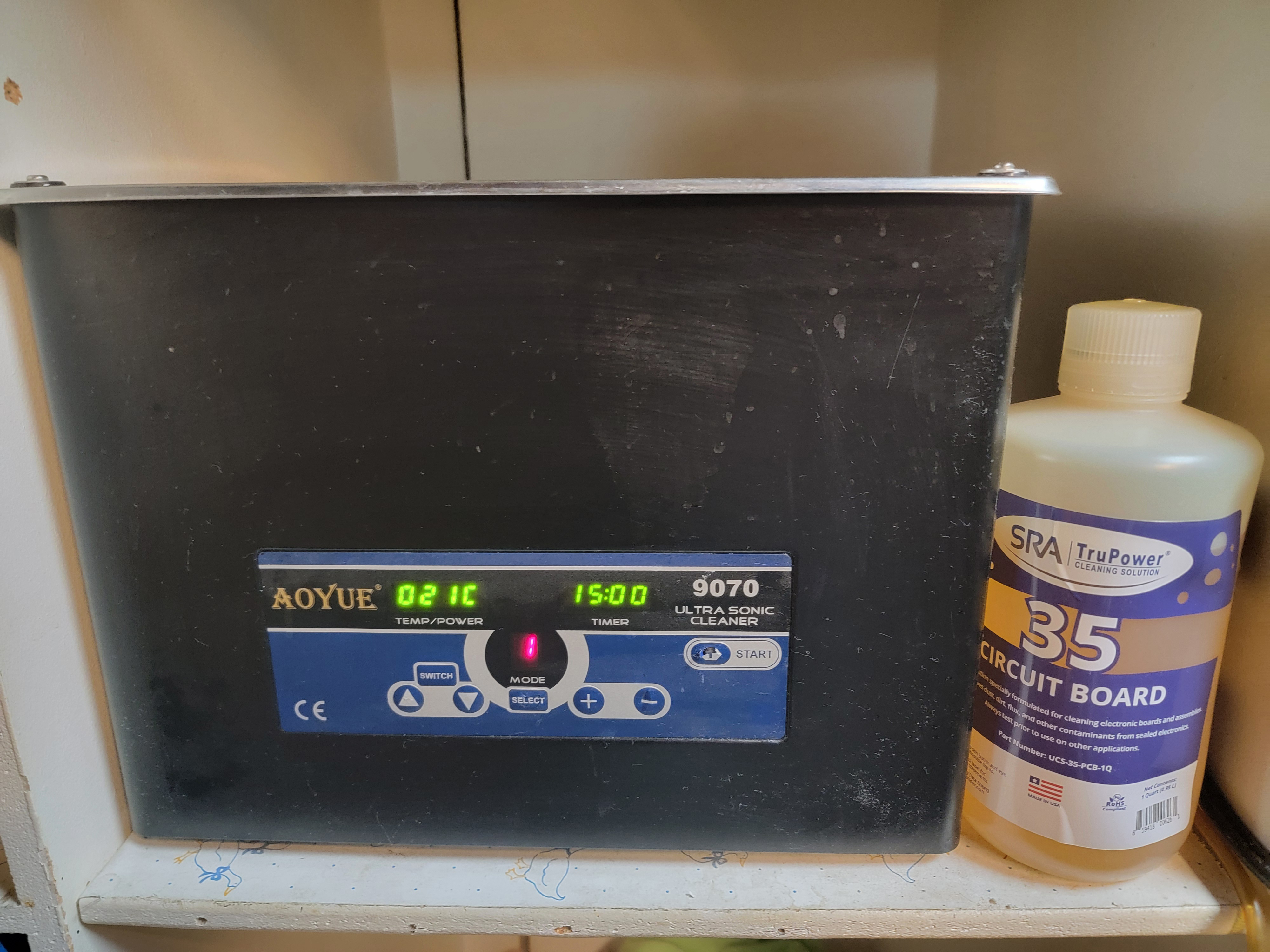
Optional PS3 ultrasonic motherboard cleaning for liquid damage, corrosion residue, heavy flux, smoke contamination, dirt, and previous repair residue. Recommended only when deep PCB cleaning provides a real benefit.
This is physical electronics repair only. This service does not include custom firmware, jailbreaks, modchips, copied games, downloaded games, piracy tools, firmware or system software modification, copyright bypassing, or instructions for accessing paid content.
Service Overview
Ultrasonic cleaning is our deepest level of PlayStation 3 motherboard cleaning, but unlike several components of our Frankenstein restoration package, this service is completely optional.
We do not believe every PS3 motherboard needs to be submerged in an ultrasonic cleaner simply because the console is already disassembled.
During normal Frankenstein rework, the motherboard is already cleaned by hand throughout the repair process. BGA areas, capacitor work, voltage-modification areas, flux residue, connectors, and surrounding circuitry are cleaned as we work.
On a normally maintained motherboard that is already clean and free of widespread contamination, that hand-cleaning process is usually enough.
In those cases, we would rather see the customer spend the additional $125 on an upgrade that provides a more meaningful electrical or thermal benefit.
Ultrasonic cleaning has become extremely popular in electronics-restoration videos because the before-and-after result looks impressive on camera. A dirty motherboard goes into a tank and comes out looking dramatically cleaner.
That visual transformation does not mean every motherboard needs the process.
A clean-looking PCB is not automatically a more reliable PCB, and ultrasonic cleaning does not correct electrical, thermal, semiconductor, BGA, or configuration problems.
It does not verify:
A motherboard can be spotless and still be electrically wrong.
Likewise, a properly repaired motherboard does not need to look freshly manufactured in order to be electrically healthy.
Our normal board-level rework already includes localized cleaning anywhere we solder, reball, rebuild, modify, or inspect.
Flux and repair residue from our own work are removed as part of performing the repair correctly.
We reserve full ultrasonic cleaning for situations where it solves an actual problem: widespread contamination, liquid residue, corrosion products, heavy previous-repair flux, nicotine, grease, smoke residue, or material trapped in areas that cannot reasonably be cleaned by hand.
We do not ultrasonic-clean a healthy motherboard simply so the service list looks longer.
If hand cleaning produces the electrical and inspection condition we need, that is sufficient.
There are situations where localized hand cleaning is not enough.
Ultrasonic cleaning becomes particularly valuable when contamination is spread across the motherboard, trapped around densely populated circuitry, underneath components, inside connector areas, or left behind from years of environmental exposure or previous repair attempts.
We strongly consider ultrasonic cleaning for boards with:
If the board is genuinely nasty, ultrasonic cleaning can transform it.
If the board is already clean, it may provide very little practical benefit.
An ultrasonic cleaner does much more than soak the motherboard in liquid.
High-frequency sound energy is introduced into the cleaning solution. This produces microscopic cavities or bubbles throughout the liquid.
These bubbles rapidly form and collapse in a process called cavitation.
The resulting microscopic agitation creates a powerful scrubbing effect across exposed surfaces and into spaces that are difficult to reach manually with a brush or swab.
This allows properly controlled ultrasonic cleaning to attack contamination around:
Liquid damage is one of the strongest reasons to consider ultrasonic cleaning.
The visible spill mark is often only part of the problem.
Liquid can travel by capillary action around component leads, underneath packages, through connector areas, and across PCB surfaces. Even after the liquid itself evaporates, dissolved minerals, sugars, salts, oils, and other contaminants can remain behind.
Depending on what was spilled, those residues may be:
A motherboard can therefore appear dry while still containing residue capable of causing corrosion, leakage paths, or intermittent electrical problems later.
For a genuinely liquid-damaged board, deep cleaning can be part of the repair rather than simply cosmetic detailing.
A printed circuit board contains thousands of electrical nodes separated by very small physical distances.
Clean fiberglass and solder mask provide excellent isolation between those circuits.
Contamination can change that environment.
Ionic residue combined with moisture can create unwanted leakage paths between conductors and can contribute to electrochemical corrosion or migration over time.
This does not mean a dirty fingerprint automatically destroys a motherboard.
It means that when we find significant unknown residue, liquid contamination, or corrosion products on an expensive restoration, removing that contamination can have an electrical reliability benefit in addition to improving appearance.
We regularly receive PlayStation 3 motherboards that have already been through one or more previous repairs.
Some are clean.
Others arrive covered in years of baked flux residue around the RSX, CELL, NEC/TOKIN banks, and other reworked areas.
Flux is required during soldering and BGA work, but the type of flux, amount used, and way the board was previously cleaned can vary dramatically.
Some modern no-clean fluxes are specifically designed so their normal residue can remain on a PCB without requiring removal.
That means the mere presence of a little flux residue does not automatically justify a $125 ultrasonic cleaning service.
However, excessive, unknown, contaminated, or repeatedly reheated flux from previous work is a different situation.
When residue has spread across large areas of the motherboard or makes proper inspection difficult, ultrasonic cleaning may be the most effective way to start again with a clean board.
This is important when deciding whether the service is worth the money.
Normal board-level cleaning is already part of our repair process.
As we perform the Frankenstein conversion we clean the areas we work on, including:
We do not finish a professional BGA conversion and leave puddles of flux, debris, or repair residue surrounding the work simply because the customer did not purchase ultrasonic cleaning.
Ultrasonic cleaning is the deep-cleaning option above and beyond the normal hand cleaning included with the repair.
Because every additional process performed on an electronic assembly should have a reason.
Ultrasonic cleaning is highly effective precisely because cavitation is an aggressive physical cleaning mechanism.
That does not automatically mean it damages a motherboard. Ultrasonic cleaning is widely used in professional electronics manufacturing and service when the process and components are suitable.
But it also does not mean that placing every populated PCB into an ultrasonic bath is completely consequence-free.
If a clean motherboard does not need aggressive deep cleaning, we see little value in exposing it to an additional process simply so we can advertise that it was ultrasonically cleaned.
A proper ultrasonic cleaning process has to consider more than whether the board looks shiny when it comes out of the tank.
Potential concerns include:
These risks can be managed with a proper electronics-cleaning process, but they are also why we do not treat ultrasonic cleaning as a harmless ritual that every motherboard automatically needs.
A professional PCB cleaning process is not complete when contamination simply dissolves.
There are three fundamental stages:
Skipping one of those stages can defeat the purpose of the cleaning process.
For example, dissolved flux remaining in dirty cleaning solution can be redeposited onto the board if the rinse process is inadequate.
Likewise, a motherboard that looks dry on its exterior may still retain moisture underneath dense components or inside connector structures.
A cleaned motherboard should never be powered while moisture remains trapped in or underneath the assembly.
Modern PCBs contain extremely small gaps around surface-mount devices, connectors, and BGA packages where liquid can be retained by surface tension.
Proper drying therefore requires enough time, airflow, and controlled conditions to make sure residual cleaning solution and moisture have been removed before electrical testing resumes.
We consider drying part of the cleaning service itself, not an optional final step.
By the time a motherboard receives a Frankenstein conversion, a significant amount of precision work has already been performed.
The board may contain:
We do not believe in adding another motherboard-level process merely because it sounds premium.
The service should solve an actual problem.
A beautifully clean PCB is easier to inspect and certainly looks better.
But once harmful contamination and repair residue have been removed, making the motherboard cosmetically cleaner does not automatically increase processor reliability.
Ultrasonic cleaning will not:
A shiny board can still be a bad repair.
A board can look factory-new and still have:
The appearance of the PCB is not our primary quality-control standard.
On a Frankenstein restoration, we are far more interested in how the motherboard behaves electrically than how dramatic it looks in a photograph.
We care about:
A good oscilloscope waveform tells us more about the health of a processor power rail than a shiny motherboard ever will.
There is nothing wrong with wanting a clean motherboard.
We want our boards clean too.
But the purpose of ultrasonic cleaning in professional electronics service is to remove contamination that is difficult or impractical to remove by normal localized cleaning.
It is not a prestige step and it is not proof that a restoration was performed correctly.
When contamination is the problem, ultrasonic cleaning is excellent.
When contamination is not the problem, doing it anyway does not magically improve the electronics.
If the motherboard is already clean and the customer has a limited upgrade budget, we normally recommend prioritizing improvements that directly affect the electrical or thermal configuration of the finished console.
Depending on the build, that money may provide more value toward:
We would rather recommend the modification that improves the console than automatically sell the service with the longest checklist.
We do not need to ultrasonic-clean a clean motherboard to prove that we performed a premium restoration.
When ultrasonic cleaning is justified, the service involves more than simply placing the board into a tank.
The process includes:
This is particularly important on liquid-damaged systems.
Cleaning can remove the contamination that caused or accelerated corrosion, but it cannot rebuild copper that has already been chemically eaten away.
After cleaning, additional repair may still be required for:
In fact, one advantage of deep cleaning is that it can expose the true condition of the board so the underlying damage can finally be seen and repaired correctly.
A heavily contaminated board can be surprisingly difficult to inspect.
Old flux, corrosion products, sticky residue, and dirt can obscure:
On those boards, ultrasonic cleaning can provide diagnostic value because we can finally examine the actual PCB rather than layers of contamination sitting on top of it.
Do not buy ultrasonic cleaning just because it sounds like something a premium restoration should include.
If your motherboard is normally clean, we already hand clean the areas being serviced as part of the Frankenstein repair. In that situation, the additional $125 will usually provide more value somewhere else in the build.
If your motherboard has liquid damage, corrosion residue, nicotine contamination, heavy previous-repair flux, or widespread dirt that cannot be properly addressed by normal hand cleaning, that is when ultrasonic cleaning becomes worth the money.
We will inspect the board and tell you which situation you have.
Clean board? Save your $125.
Nasty board? Then let's clean it properly while we already have the console completely apart.
We clean contamination because contamination is a problem - not because a shiny motherboard makes a better thumbnail.
Premium Packages Customized to your budget.
Related Service Options
Most premium restorations combine multiple hardware services depending
on the condition of the console.