🧠
40nm Premium RSX Swap / Replacement
Our preferred Frankenstein RSX: factory bare-die 40nm silicon from select Super Slim MSX/MPX donors with a completely renewed die-level thermal interface.
View service details → iKon Technical SolutionsPS3 Hardware Restoration
PS3 Frankenstein Repair Service
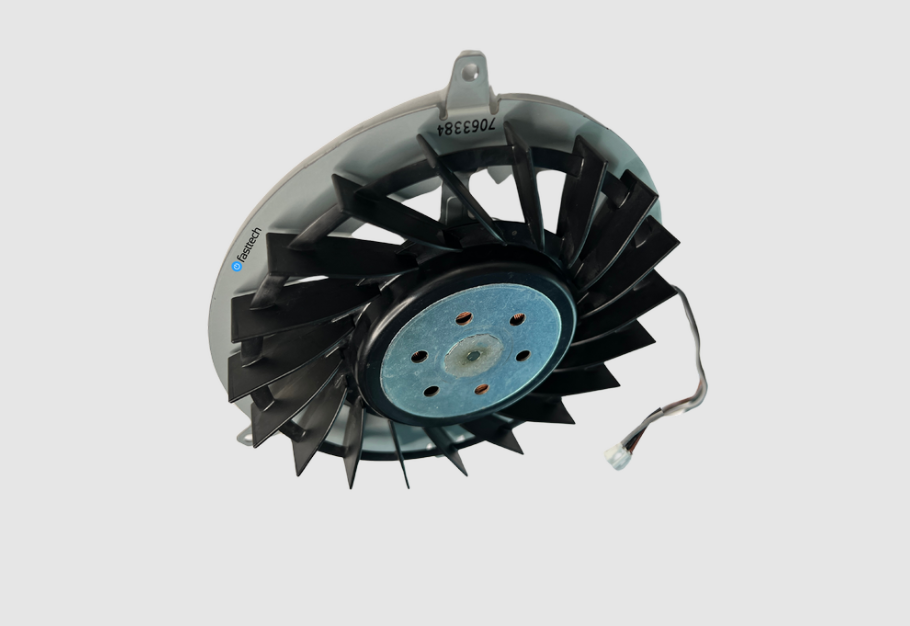
OEM PS3 19-blade fan upgrade for backwards-compatible FAT PlayStation 3 consoles. Improved cooling-to-noise performance, airflow and thermal management for Frankenstein restoration builds.
This is physical electronics repair only. This service does not include custom firmware, jailbreaks, modchips, copied games, downloaded games, piracy tools, firmware or system software modification, copyright bypassing, or instructions for accessing paid content.
Service Overview
The 19-blade fan upgrade replaces selected 15-blade FAT PlayStation 3 fan configurations with the OEM NMB-MAT BG1402-B045-P00 19-blade assembly. Rather than simply increasing fan speed, the objective is to improve the relationship between airflow, static pressure, rotational speed and acoustic output inside the restrictive FAT PS3 chassis.
The backwards-compatible PS3 is not an open-air cooling system. Air must be pulled through chassis openings and directed across densely packed heatsink fins, motherboard assemblies, shielding and the internal power-supply area. Because of this resistance, cooling performance depends on more than raw fan RPM alone.
A common misconception is that more blades automatically means more airflow. Fan performance is determined by the entire aerodynamic design, including blade shape, pitch, surface area, rotational speed, motor characteristics, housing geometry and the resistance of the cooling path.
The 19-blade NMB fan uses a different impeller design than the various 15-blade fans installed across FAT PS3 production. The additional blade area allows the fan to develop useful airflow through the console's restrictive heatsink and chassis path without depending entirely on higher rotational speed.
This is particularly important inside an early FAT PS3 because maintaining airflow through the heatsink fins requires both airflow volume and static-pressure capability. A fan that performs well in unrestricted air does not necessarily perform the same way once installed inside the complete console.
The PS3 controls the cooling fan electronically using PWM. A given fan-control percentage represents a control command, not a universal rotational speed.
Different OEM fan models can operate at different RPM, move different amounts of air and produce different sound levels at the same commanded fan percentage. This is why simply comparing a 15-blade and 19-blade fan at the same percentage does not completely describe their real-world cooling performance.
The primary advantage of the 19-blade configuration is its cooling-to-noise behavior. In a properly restored console, the fan can provide strong airflow through the CELL and RSX heatsink assemblies without requiring the cooling system to rely solely on very high fan speeds.
Lower rotational speed can also reduce some of the motor, turbulence and high-speed airflow noise normally associated with an aggressively ramping FAT PS3 fan. The result can be a console that maintains its thermal target with a less intrusive acoustic profile during normal operation.
| Fan | Blades | Electrical Rating | Characteristics |
|---|---|---|---|
| NMB-MAT BG1402-B045-P00 | 19 | 12V / 2.90A | Our preferred high-performance OEM cooling configuration with excellent cooling-to-noise characteristics. |
| Nidec D14F12BS1-01H1 | 15 | 12V / 2.65A | Powerful OEM fan capable of excellent cooling performance, but can operate with a more noticeable acoustic profile depending on fan control. |
| NMB-MAT BG1402-B045-P00 | 15 | 12V / 2.20A | OEM 15-blade version with different aerodynamic and electrical characteristics from the 19-blade assembly. |
| Nidec G14 Series | 15 | 12V / approximately 1.75A | Lower-current OEM fan design used in selected FAT PS3 configurations. |
Not necessarily. Fan RPM, airflow and electrical power consumption are separate measurements. The 19-blade NMB fan carries a higher maximum electrical rating than several 15-blade PS3 fan models, so we do not market this upgrade as an electrical power-saving modification.
Its advantage is instead the ability to provide favorable airflow, pressure and acoustic performance within the PS3 cooling system. Actual fan current varies with operating speed and PWM control and is far below the nameplate maximum during normal low-speed operation.
A cooling system should not have to operate near its upper fan range during normal gameplay just to maintain acceptable temperatures. High fan speeds increase noise and can indicate that the cooling system is compensating for excessive heat production, poor thermal transfer or restricted airflow elsewhere in the system.
Our objective is to reduce heat at the source and improve the complete thermal path so the fan can remain in an efficient operating range rather than using excessive RPM as a substitute for proper restoration.
The 19-blade fan is most effective when used as one component of a complete thermal strategy. A fan cannot compensate for a failed RSX, poor die-to-heatsink thermal transfer, degraded thermal materials or excessive system power consumption.
On a premium Frankenstein restoration, fan selection works together with a lower-power RSX configuration, fresh thermal-interface materials, thermal-pad replacement, appropriate CELL service, power-supply selection, CELL/RSX voltage optimization and complete internal cleaning.
Each improvement addresses a different part of the thermal system:
Simply forcing a PS3 fan to an aggressive fixed speed can lower temperature readings, but it does not correct the underlying reason a console is producing or retaining excessive heat.
Our restoration philosophy is different. The hardware is repaired first, thermal transfer is restored, system power is optimized where appropriate, and the cooling system is then configured to maintain stable temperatures without unnecessary fan noise.
Important: Fan condition, bearing condition, motherboard revision, heatsink design and wiring compatibility are verified before installation. Because Sony used multiple FAT PS3 cooling assemblies during production, fan performance should be evaluated as part of the complete thermal system rather than by blade count alone.
Premium Packages Customized to your budget.
Related Service Options
Most premium restorations combine multiple hardware services depending
on the condition of the console.