🧠
40nm Premium RSX Swap / Replacement
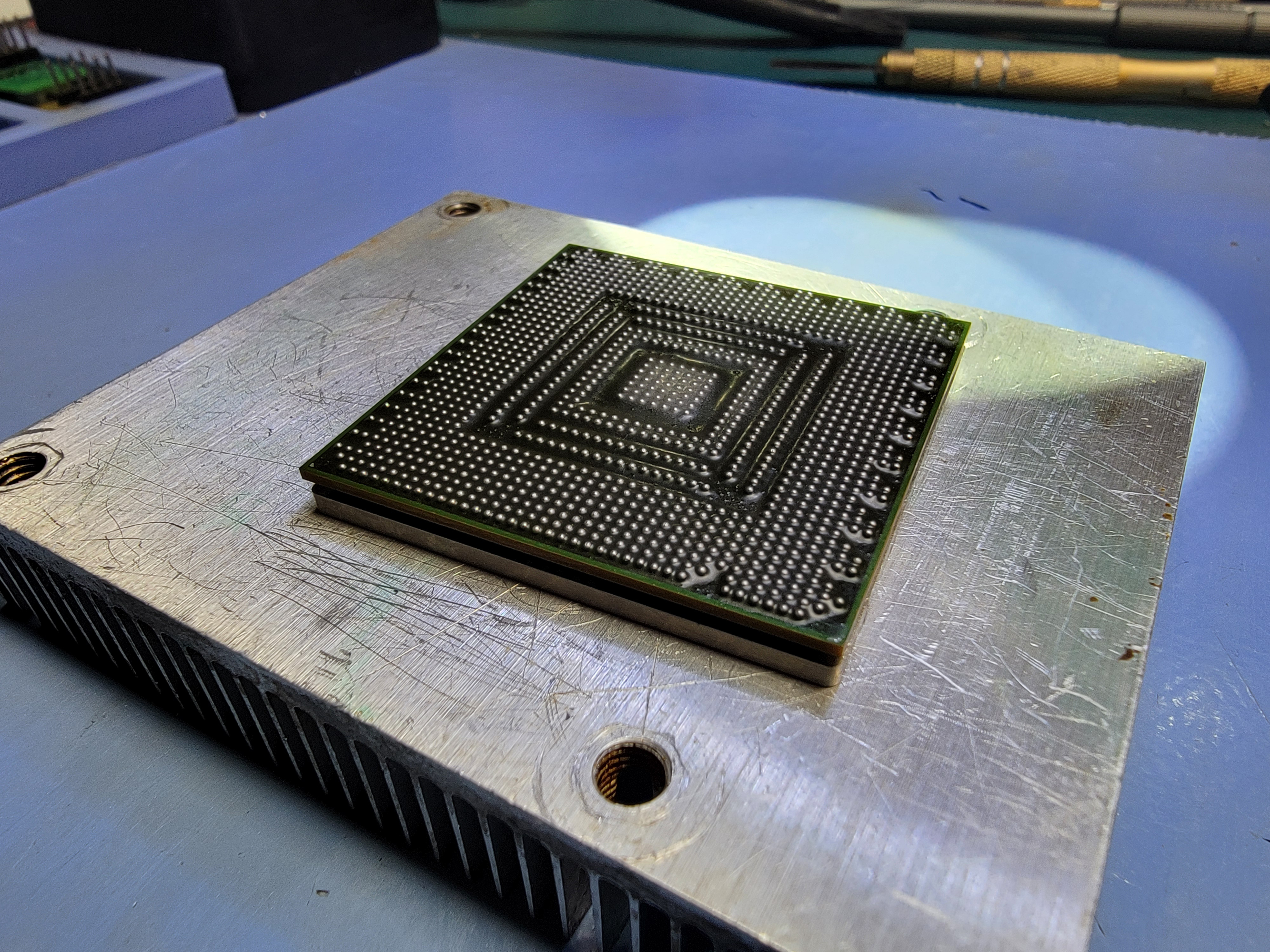
Our preferred Frankenstein RSX: factory bare-die 40nm silicon from select Super Slim MSX/MPX donors with a completely renewed die-level thermal interface.
View service details → iKon Technical SolutionsPS3 Hardware Restoration
PS3 Frankenstein Repair Service
Professional PS3 40nm RSX Frankenstein replacement using later Slim GPU silicon. Lower-power RSX conversion for backwards compatible FAT PS3 systems, with optional factory bare-die 40nm upgrade.
This is physical electronics repair only. This service does not include custom firmware, jailbreaks, modchips, copied games, downloaded games, piracy tools, firmware or system software modification, copyright bypassing, or instructions for accessing paid content.
Service Overview
The 40nm RSX conversion replaces the original early-generation RSX graphics processor in a compatible FAT PlayStation 3 with a later, more efficient 40nm RSX originally used in Slim-era PS3 hardware.
This is the foundation of what is commonly called a PS3 Frankenstein conversion. The original GPU is physically removed from the motherboard, the BGA site is professionally prepared, the replacement RSX is installed, and the electrical and firmware configuration of the console is adapted to operate with the later processor.
This is not a heat-gun repair, reflow, pressure modification or attempt to temporarily revive an internally damaged RSX. The original processor is replaced.
The early backwards-compatible PlayStation 3 systems were built around large 90nm RSX processors. These processors operate at considerably higher power and thermal loads than the later RSX revisions Sony introduced as the PlayStation 3 platform evolved.
When an original RSX develops an internal failure, reheating the processor does not replace damaged silicon, internal interconnections or package structures. A Frankenstein conversion takes a different approach: remove the original failure point and replace it with a later-generation processor.
A 40nm RSX is manufactured on a substantially smaller semiconductor process than the original 90nm GPU. The later silicon operates at a lower core voltage and generally produces substantially less heat for the same PS3 workload.
This is extensive BGA and board-level rework. The console is completely disassembled and the motherboard is evaluated before a replacement processor is installed.
The conversion can include:
A later 40nm RSX is not electrically identical to the original 90nm processor.
The 40nm silicon was designed around a lower RSX core operating voltage. A proper Frankenstein conversion therefore requires the motherboard's RSX power configuration to be adapted for the replacement processor rather than simply installing the chip and applying the original 90nm operating conditions.
This conversion-specific voltage configuration is different from our optional CELL/RSX undervolting service. The first establishes the correct electrical environment required by the replacement RSX. Additional undervolting is a separate optimization used to further reduce system power and heat where stability testing allows it.
A 40nm RSX cannot simply be installed into every FAT PS3 without considering firmware and motherboard configuration.
The console must contain software support for the later RSX revision. Board revision, installed firmware, flash configuration, previous repair history and SYS_CON information are evaluated before determining the appropriate conversion path.
On systems where the existing firmware environment does not support the desired processor, additional flash-level work may be necessary. In some circumstances a 65nm RSX may be the more practical conversion unless the additional firmware work is justified.
We offer both qualified used donor processors and NOS 40nm RSX options when inventory is available.
A used donor RSX is not selected simply because the donor console produced video. Candidate processors are inspected and electrically evaluated before installation. Chips showing abnormal rail characteristics or other indications that make them questionable for a premium restoration are rejected.
NOS inventory provides the option of unused replacement silicon when available, but proper handling, electrical verification and installation remain equally important regardless of processor source.
The standard 40nm conversion uses the later RSX package commonly sourced from compatible Slim PlayStation 3 hardware. These processors normally retain their original integrated heat spreader, or IHS.
We normally leave that IHS exactly where Sony put it.
A good 40nm RSX does not need to be delidded merely because direct access to the silicon might reduce one thermal interface.
Our priority is preserving the mechanical integrity of the replacement processor.
Our normal policy is to avoid mechanically delidding a conventional 40nm Slim RSX.
The RSX is a multilayer semiconductor package containing the silicon die, substrate, underfill, memory components and thousands of BGA connections beneath the package. Removing a bonded heat spreader requires force to be introduced into that completed semiconductor assembly.
Even when a delid appears successful externally, unnecessary bending, twisting or lifting of the package can introduce mechanical stress that may not be visible under an ordinary microscope.
For an expensive Frankenstein restoration, we do not believe the small potential thermal advantage of routinely delidding a healthy 40nm Slim RSX justifies deliberately introducing that additional package-level risk.
This is one of the major differences in our approach.
If a customer wants the advantages of an exposed 40nm RSX die, our first recommendation is not to mechanically remove the IHS from their good Slim RSX.
We would rather replace that processor with our factory bare-die 40nm RSX option.
The factory bare-die processor gives us access to the silicon without performing an aftermarket delid on the replacement chip.
Why take a good 40nm RSX, mechanically modify its package and accept the additional risk when Sony already manufactured a 40nm version with the die exposed from the factory?
For customers already purchasing a 40nm Frankenstein conversion, we strongly recommend considering our Premium factory bare-die 40nm RSX upgrade.
For approximately $60 more than the standard used 40nm configuration, we can install a verified factory bare-die 40nm RSX sourced from compatible early Super Slim donor hardware.
We have developed a repeatable donor-sourcing program around selected early Super Slim systems, including 2012 production hardware, and maintain inventory specifically for Premium Frankenstein conversions.
Each donor processor is still individually inspected and evaluated before installation. Donor model or production year alone does not automatically qualify a chip for customer use.
The Premium processor arrives with its 40nm silicon die already exposed as part of the factory package design.
That means:
This is our preferred 40nm configuration when the customer wants the highest-level Frankenstein build we offer.
This distinction is important.
The factory bare-die Super Slim RSX is physically lower than the original lidded RSX assembly used in the backwards-compatible FAT PS3. The FAT heatsink and heat-pipe system was designed around the original processor stack height.
After the factory bare-die 40nm RSX is installed, we clean and prepare the original 90nm RSX integrated heat spreader from the FAT console and reuse it above the replacement processor.
This restores the thermal and mechanical height required to properly interface with the original FAT PS3 heatsink assembly.
Our Premium thermal stack therefore consists of:
The advantage is not eliminating the IHS from the completed FAT PS3. The advantage is gaining access to the 40nm silicon without having to delid the replacement processor to get there.
There are unusual situations where retaining a particular conventional 40nm processor may make more sense than replacing it.
In those cases, a 40nm delid can be considered, but we treat it as an exceptional high-risk procedure rather than routine service.
When a 40nm RSX delid is genuinely necessary, we can use a chemical-assisted process intended to weaken the IHS bonding material before separation and reduce the amount of mechanical force required.
That process can reduce mechanical stress, but it cannot make delidding risk-free.
Our order of preference is simple:
For most customers already paying for a Frankenstein conversion, spending the additional money on the factory bare-die processor makes considerably more sense to us than paying to perform a higher-risk delid on the standard Slim RSX.
Moving from the original 90nm RSX to later 40nm silicon represents a major semiconductor-generation change.
The smaller process allows the later processor to operate at substantially lower voltage and power than the original early RSX while performing the same PS3 graphics workload.
Lower processor power means less electrical energy ultimately becomes heat inside the chassis.
That reduction benefits more than the RSX temperature itself. It reduces the thermal load that must be handled by the IHS, heatsink, heat pipes, cooling fan and internal power supply environment.
This is why we view the 40nm conversion as more than simply replacing a failed GPU. It changes the thermal characteristics of the entire restored console.
A 40nm processor is an important improvement, but it is still only one component of the system.
Our premium Frankenstein configuration can combine:
The objective is not simply to make a failed PlayStation 3 boot again. The objective is to remove the original failure point and rebuild the system around a more efficient electrical, thermal and mechanical configuration.
Standard 40nm: an excellent Frankenstein conversion using later Slim RSX silicon while retaining the processor's original factory-installed IHS. This is already a substantial improvement over the original 90nm RSX.
Premium factory bare-die 40nm: our preferred no-compromise configuration. The replacement processor was manufactured with the silicon exposed, allowing us to build a premium die-level thermal interface without subjecting the 40nm package to an aftermarket delid.
For customers watching the total build cost, the standard 40nm remains an excellent choice.
For customers already investing in a premium backwards-compatible PS3 restoration and planning to keep the system long term, the factory bare-die upgrade is the option we recommend.
The standard 40nm Slim RSX is already an excellent upgrade. We just do not believe in mechanically delidding a healthy one unless there is a very good reason.
If the goal is simply a reliable 40nm Frankenstein conversion, we install the standard lidded processor and leave the factory package intact.
If the goal is the best 40nm configuration we currently offer, spend the additional $60 and move to the factory bare-die version.
That gives us direct access to factory-exposed 40nm silicon, allows the use of our premium die-level thermal configuration, retains the original FAT cooling geometry through the restored 90nm IHS, and eliminates the need to mechanically delid the replacement RSX.
We would rather install the right processor than take an unnecessary risk modifying a perfectly good one.
Premium Packages Customized to your budget.
Related Service Options
Most premium restorations combine multiple hardware services depending
on the condition of the console.