🧠
40nm Premium RSX Swap / Replacement
Our preferred Frankenstein RSX: factory bare-die 40nm silicon from select Super Slim MSX/MPX donors with a completely renewed die-level thermal interface.
View service details → iKon Technical SolutionsPS3 Hardware Restoration
PS3 Frankenstein Repair Service
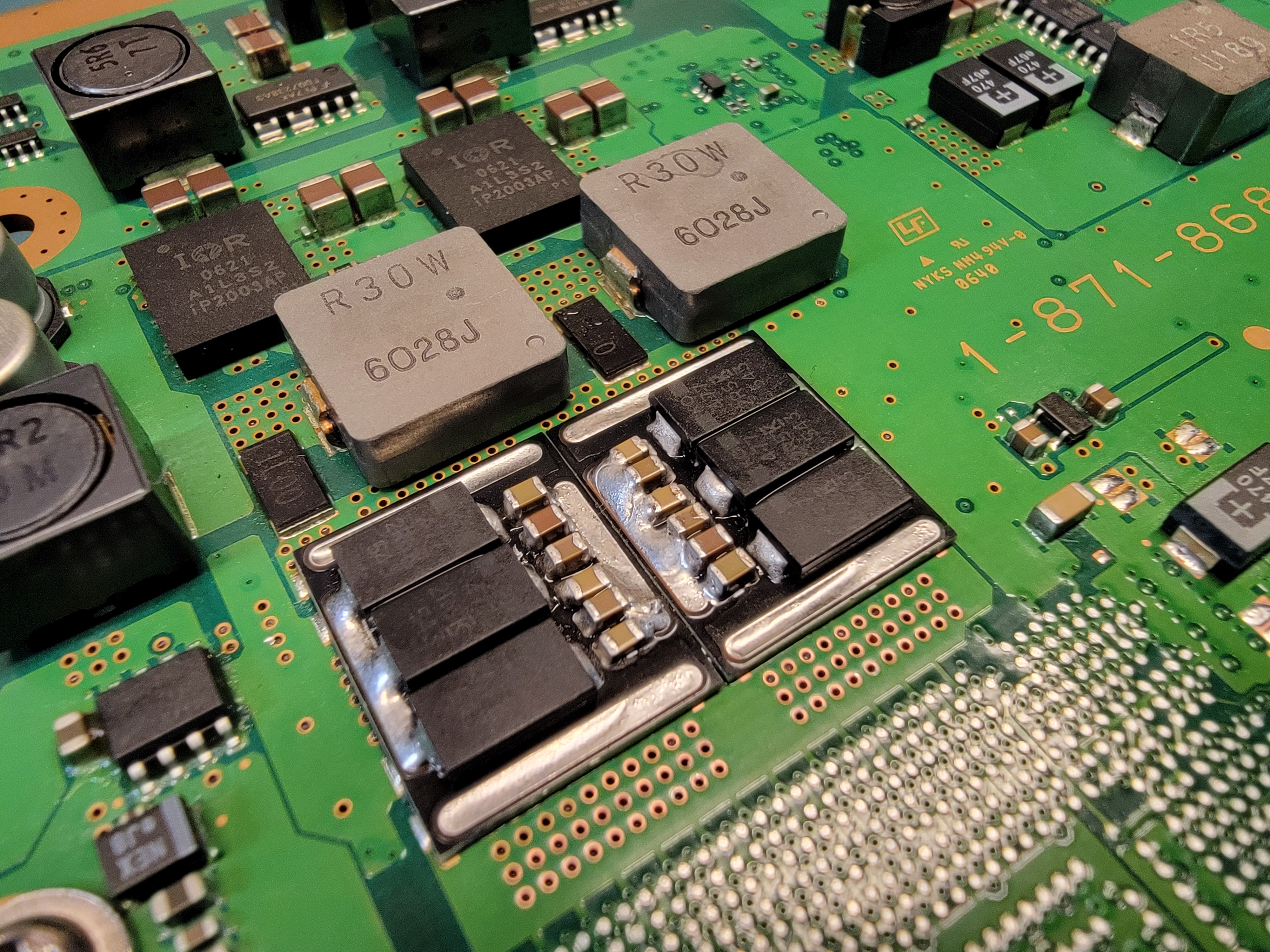
Required PS3 Frankenstein NEC/TOKIN power rail rebuild using new low-ESR polymer capacitors and premium MLCC decoupling for CELL and RSX VDDC stability, transient response, ripple control and long-term reliability.
This is physical electronics repair only. This service does not include custom firmware, jailbreaks, modchips, copied games, downloaded games, piracy tools, firmware or system software modification, copyright bypassing, or instructions for accessing paid content.
Service Overview
Our NEC/TOKIN service is not an optional cosmetic upgrade and it is not something we perform only after a capacitor has completely failed.
On applicable FAT PlayStation 3 Frankenstein builds, the NEC/TOKIN power rail rebuild is part of our required base restoration package.
The reason is electrical.
The CELL and RSX are extremely high-current processors operating from very low core voltages. Their current demand changes constantly as processor activity changes. The motherboard voltage regulators must therefore maintain an exceptionally stable VDDC supply while responding to extremely fast changes in load.
The original NEC/TOKIN Proadlizers are a major part of that power-delivery system.
They are not simply large capacitors placed on the board because Sony needed additional capacitance. They are specialized low-impedance decoupling devices positioned around the CELL and RSX power domains to help provide transient current, suppress rail noise and maintain power integrity across a wide frequency range.
A processor power rail is not adequately described by saying it has a certain number of microfarads attached to it.
Several electrical characteristics matter:
This is why replacing an NEC/TOKIN Proadlizer is not as simple as finding another capacitor with a similar capacitance number printed on it.
The original NEC/TOKIN Proadlizer was designed as a broadband decoupling device for high-speed digital power systems.
Its electrical construction allowed it to provide substantial local capacitance while maintaining very low impedance across a useful frequency range.
That matters around processors such as CELL and RSX because processor load does not change slowly and predictably. Digital logic can change current demand extremely quickly as execution units, memory interfaces and graphics workloads become active and inactive.
The local decoupling network must supply and absorb those rapid current changes during the short period before the main voltage-regulation system can fully respond.
That is the job these devices were performing beneath the CELL and RSX power networks.
A Frankenstein conversion is major motherboard-level rework.
We remove the original RSX, prepare the BGA site, install later-generation silicon, configure the motherboard electrically for that processor, restore the thermal system and then expect the completed console to operate reliably for years.
After doing that amount of work, we are not willing to leave one of the most important parts of the processor power-delivery network entirely dependent on aging original decoupling hardware simply because it happens to still function today.
A functioning NEC/TOKIN is not necessarily a failed NEC/TOKIN. We understand that.
But this is a long-term restoration, not a minimum-parts repair.
If the motherboard contains 15-to-20-year-old processor-decoupling hardware directly supporting the two highest-current semiconductor devices in the console, we address it while the motherboard is already undergoing complete restoration.
That may be completely true.
There are original NEC/TOKIN Proadlizers still functioning today, and we do not claim that every original device is electrically defective simply because of its age.
That is not why this service is mandatory.
The reason is that a premium Frankenstein restoration is already taking the motherboard through the most extensive service it is likely to receive:
This is the time to address the aging processor power network.
Leaving the original NEC/TOKIN system untouched simply because it still works today can mean reopening the same expensive restoration later if that power-delivery network becomes the next age-related problem.
We would rather complete the work while the motherboard is already on the bench than deliberately leave a known aging subsystem behind and subject the console to another complete teardown and another round of board-level repair in the future.
If we are already doing the major surgery, we finish the job.
There is another major difference between our service and some low-cost or DIY-style NEC/TOKIN conversions.
We do not populate our customer boards with used polymer capacitors, MLCCs or resistor components harvested from 10-to-15-year-old donor PlayStation 3 motherboards.
A salvaged component may still function. That does not make it the component we want to install into a premium long-term restoration.
When we are charging a customer for a complete processor power-rail rebuild, our position is simple:
The replacement components should actually be new.
Later Slim PlayStation 3 motherboards can contain perfectly usable polymer and ceramic capacitors, and harvesting those components can be an inexpensive way to complete a hobby repair.
That is not the standard we use for a commercial Frankenstein restoration.
A donor capacitor has already experienced an unknown combination of:
It also has to be desoldered from one motherboard and soldered onto another, adding another complete thermal event to a component that has already spent years in service.
When new-production components from established manufacturers are available, we see no reason to build an expensive restoration around unknown-history donor capacitors simply to save a few dollars.
Our polymer capacitors and MLCCs are purchased as new electronic components.
We source from established manufacturers and major electronic-component distribution channels whenever possible.
Our current component strategy includes manufacturers such as:
Exact manufacturer part numbers can change as component lines are revised or discontinued, but our component-selection criteria do not.
Replacement parts are evaluated for:
Cost matters when selecting hundreds or thousands of production components, but saving pennies inside the processor power network is not our priority.
A ceramic capacitor that costs only a few cents and another that costs twenty, thirty or fifty cents can share the same nominal capacitance while using different dielectric systems, voltage ratings, tolerance specifications and DC-bias characteristics.
For example, an MLCC advertised as 10µF does not necessarily provide its full nominal capacitance once real DC voltage is applied.
Higher-quality components from established manufacturers provide characterization data that allows us to make an informed selection rather than relying on a marketplace listing that simply says "10µF 0805."
We are willing to spend twenty cents on the correct MLCC instead of one cent on an unknown part because the capacitor is going into the core-power network of a processor we just spent hours replacing.
Our current NEC/TOKIN replacement design uses brand-new 470µF, 2.5V low-ESR conductive-polymer capacitors with approximately 7mΩ ESR in parallel configurations at the original decoupling locations.
We currently use three 470µF polymer capacitors per applicable NEC/TOKIN bank.
That provides approximately:
Paralleling capacitors also reduces the effective ESR of the combined bank and distributes ripple current across multiple devices.
But we deliberately do not stop there.
Large polymer capacitors provide excellent bulk energy storage and low-frequency transient support, but processor power integrity extends far beyond bulk capacitance.
That is why our rebuild also incorporates a deliberate multi-value MLCC decoupling network.
Our current component set includes premium 0805 ceramic capacitors across values such as:
The reason for using a range of values is not decorative and it is not simply to increase the total microfarad number.
Different capacitor values and physical constructions have different frequency-dependent impedance and self-resonant behavior.
By combining bulk low-ESR polymer capacitance with multiple ceramic values, we can support the processor rail across a broader portion of the transient spectrum than we would by installing only large polymer capacitors.
That is the simplified way to understand our design.
Polymer capacitors provide:
MLCCs provide:
The two technologies complement each other.
Installing only salvaged polymer capacitors may produce a functioning console. That is not the same thing as intentionally rebuilding the broadband decoupling network.
The original NEC/TOKIN Proadlizer was a specialized device with electrical characteristics that cannot be perfectly described by capacitance alone.
It would therefore be technically dishonest to claim that several ordinary capacitors automatically become electrically identical to the original component merely because the total capacitance is similar.
Our objective is different.
We build a modern low-impedance replacement network using complementary capacitor technologies and then evaluate how the actual processor rail behaves.
That is a much more meaningful engineering standard than comparing only the number of microfarads.
A digital multimeter is excellent for verifying the average voltage of a processor rail.
It cannot show the complete electrical behavior of that rail over time.
A VDDC rail may measure exactly the expected voltage on a multimeter while still containing:
An oscilloscope lets us examine the actual waveform instead of relying only on the average DC value.
The meter tells us where the rail is centered. The oscilloscope tells us how cleanly it gets there and how well it stays there.
The CELL and RSX can change current demand extremely quickly.
Imagine the RSX moving from a relatively light menu workload into a demanding game scene.
Processor activity increases.
Current demand rises.
The main voltage regulator detects that change and responds, but it cannot deliver an instantaneous response with zero delay.
During that short interval, the local capacitor network supplies current directly to the processor.
If the local network has excessive impedance, the rail voltage can temporarily fall.
That is transient droop.
When load suddenly decreases, the opposite problem can occur. Energy already present in the regulator and power network can temporarily push the rail above its normal target.
That is overshoot.
The job of the voltage regulator and decoupling network is to control both behaviors and return the rail quickly to its normal operating level.
There is no single magical oscilloscope picture that applies to every PS3 motherboard, probe location and workload.
What we want to see is controlled rail behavior:
The exact measurement must also be interpreted with the probe location, bandwidth, coupling mode and load condition in mind.
One of the real-world changes we frequently notice after rebuilding the NEC/TOKIN network is that some systems simply seem to come alive more decisively.
Before the rebuild, a console may power on and eventually reach the XMB normally, but the startup can feel hesitant compared with the same board after its processor power network has been rebuilt.
Afterward, the behavior can feel more like:
Power button → initialization → XMB.
Almost immediately.
There is a good electrical reason why improved power integrity can contribute to that behavior.
The CELL and RSX do not begin operating from an already established power condition.
When the console starts, multiple regulated supplies have to come up in the required sequence.
The processor power rails must:
Only then can the rest of the startup sequence continue correctly through clocks, reset release, hardware initialization and the software boot process.
The console is not merely asking whether VDDC exists. It needs VDDC to behave correctly while the processors begin operating.
We want to be technically precise about this.
The PlayStation 3 has a defined power-up and initialization sequence. We are not claiming that Sony programmed a variable timer that sits there waiting for old NEC/TOKIN capacitors to become ready.
What changes is the electrical environment underneath that startup sequence.
An aging or marginal decoupling network can potentially produce poorer rail behavior during power-up:
A strong low-impedance replacement network gives the VRM a better local energy reservoir and better high-frequency support during that transition.
The startup sequence itself has not changed.
We improved the electrical conditions that sequence depends on.
In simplified terms, a strong processor power network behaves more like:
VRM rises → local capacitance charges → rail settles → processor load arrives → decoupling network supports the transient → rail remains controlled → initialization continues.
A marginal network can behave more like:
VRM rises → rail approaches target → processor load arrives → voltage droops or rings → regulator corrects → rail recovers → initialization continues with less electrical margin.
Both systems may eventually boot.
But they are not necessarily presenting the CELL and RSX with the same quality of power while they do it.
The CELL and RSX are among the largest electrical loads on the motherboard.
At startup, the system transitions rapidly from a mostly inactive state into one where processors, clocks, memory interfaces and other supporting circuitry begin operating.
That creates exactly the type of changing load where a low-impedance local decoupling network matters.
With strong bulk polymer capacitance and local MLCC support already charged and available, the processors have immediate local transient current available while the VRM responds to changing demand.
The cleaner and more controlled that transition is, the less electrical drama exists underneath the boot sequence.
An original NEC/TOKIN network can still successfully boot a console and therefore technically still be functioning.
That does not tell us how much margin remains in the power-delivery system.
There can be a substantial difference between:
"The console successfully powered on."
and:
"The CELL and RSX power rails came up cleanly, remained controlled through startup transients and continued to behave properly under load."
Our objective is the second one.
We do not use a fast-looking startup by itself as proof that the NEC/TOKIN rebuild is electrically correct.
Many things affect how long a PS3 takes to reach the XMB, including:
But when the same motherboard changes noticeably after its processor decoupling network is rebuilt, that observation is consistent with improved startup power integrity.
It is something we notice, but the oscilloscope and electrical testing are what tell us why power integrity matters.
This really summarizes the entire NEC/TOKIN service.
The processor does not know:
The processor experiences the electrical result.
The CELL and RSX do not care how new the capacitor looks. They care what the VDDC waveform looks like when they ask for current.
That applies during a demanding game.
It applies during a rapid workload transition.
And it applies during the first moments after the power button is pressed.
A low-voltage processor rail can be extremely easy to measure incorrectly.
A long oscilloscope ground lead adds inductance and can act like an antenna, making the measurement show spikes or ringing created by the probe itself rather than the motherboard.
For meaningful power-integrity measurements, we keep the measurement path short and probe as close as practical to the rail location being evaluated.
Bandwidth limiting and AC coupling can also be used where appropriate to examine small ripple components riding on top of the larger DC rail.
Owning an oscilloscope and touching a probe to VDDC is not the same thing as making a trustworthy power-integrity measurement.
The PlayStation 3 continuously monitors numerous electrical conditions and stores hardware fault information through SYS_CON.
Relevant CELL and RSX power faults can be associated with unstable VDDC behavior, excessive ripple, voltage-regulation problems or insufficient filtering.
This is why a console can appear completely normal at the XMB but fail once a game places a rapidly changing load on the processors.
The system is not only asking whether voltage exists.
It needs that voltage to remain within an acceptable electrical window while current demand changes.
This is one of the easiest ways to understand why decoupling matters.
A meter can report:
1.000V
and make the rail appear perfect.
But between the meter's averaged measurements, the actual waveform could briefly look more like:
1.000V → 0.930V → 1.035V → 0.985V → 1.000V
during a rapid load transition.
The exact values vary by circuit and test condition, but the concept is important.
The processor experiences the instantaneous waveform. It does not experience the averaged number displayed by the multimeter.
This is equally important.
A YLOD does not automatically mean bad NEC/TOKIN capacitors.
The PlayStation 3 can shut down for many different reasons:
A failed RSX cannot be repaired by installing capacitors.
A dead CELL cannot be repaired by installing capacitors.
A shorted semiconductor cannot be repaired by adding more capacitance.
That is why proper diagnosis comes first.
The NEC/TOKIN rebuild has a specific purpose: restore and modernize the CELL and RSX processor power-decoupling network.
We do not replace one suspicious NEC/TOKIN and leave the remaining processor power network untouched.
On applicable Frankenstein motherboards, we rebuild the complete critical NEC/TOKIN network supporting the CELL and RSX.
That keeps the finished system from containing one newly rebuilt bank surrounded by multiple original aging devices with unknown remaining service life.
If we are rebuilding the power rail, we rebuild the power rail.
A Frankenstein conversion represents too much labor, too much specialized equipment and too much value to compromise the completed build over inexpensive electronic components.
Removing a polymer capacitor, MLCC or resistor from a donor motherboard may save a few dollars in materials.
It also introduces an unknown-history component into a system that is specifically being sold as a professional long-term restoration.
That tradeoff does not make sense to us.
We would rather purchase the correct new KEMET polymer capacitor, Murata MLCC, Samsung MLCC or other qualified production component and know exactly what we installed.
There is nothing inherently wrong with a hobbyist experimenting on their own hardware using donor components, inexpensive capacitor conversions or whatever parts are available on the bench.
That is not the service we are selling.
A customer paying for a professional Frankenstein restoration is paying us specifically so that the component sourcing, engineering decisions, BGA work, electrical testing and final qualification are handled at a professional standard.
Our builds are not assembled around "whatever good parts we could pull from another PS3."
We maintain dedicated inventory of new-production components because we want the replacement power network to be one of the newest electrical systems in the console, not another collection of 15-year-old donor parts.
This is another major reason the NEC/TOKIN rebuild is mandatory.
The motherboard is already on the rework bench.
The original RSX is already being removed.
The board is already undergoing controlled heating.
The BGA site is already being prepared.
The motherboard is already being inspected, cleaned and electrically tested.
This is the most logical time the console will ever have to receive a complete processor power-rail rebuild.
Choosing to leave the original NEC/TOKIN network simply because it has not failed yet saves money today at the expense of leaving another aging subsystem in a motherboard we are otherwise rebuilding for long-term use.
If those components later become a problem, the system has to come apart again.
The motherboard has to be handled again.
Another repair operation has to be performed.
Another shipping cycle may be required.
Another opportunity for mechanical and thermal stress is introduced.
We would rather do the work once, while the console is already completely apart, and close the machine knowing the processor power network has been addressed.
Customers occasionally ask whether NEC/TOKIN replacement can be removed from the Frankenstein package to reduce the repair price.
For applicable motherboards, the answer is no.
Our warranty is based on the completed electrical configuration we are willing to stand behind.
We are not interested in installing an expensive replacement RSX, performing professional BGA work and then returning the console with the original processor-decoupling network untouched to save part of the repair cost.
The $150 NEC/TOKIN power rail rebuild is therefore part of the foundation of our Frankenstein service.
It should be viewed the same way as the required RSX voltage and resistor configuration: it is part of how we build the system, not a cosmetic add-on selected from a menu.
Our current rebuild architecture combines:
Individual part numbers may change as manufacturers discontinue or revise product lines, but we requalify replacement components against the same electrical requirements rather than automatically substituting the cheapest available part.
The NEC/TOKIN rebuild works together with the rest of our electrical restoration:
These services perform different jobs, but they all contribute to the same objective: a stable electrical system.
A lower-power RSX still requires clean power.
An undervolted processor still requires clean power.
A perfect BGA installation still requires clean power.
Everything depends on the quality of the rail feeding it.
We are not building customer Frankenstein systems from piles of used donor capacitors.
We are not removing fifteen-year-old polymer capacitors from one PlayStation 3 and calling them "new" when they are installed onto another.
We are not omitting the high-frequency MLCC portion of the decoupling network simply because a console can boot with bulk capacitance alone.
And we are not choosing a one-cent anonymous component when a properly characterized premium part costs twenty cents.
This service uses brand-new, intentionally selected polymer and ceramic components because we are rebuilding a critical processor power-delivery system, not performing the minimum modification required to make a YouTube video end with a working XMB screen.
Booting is the beginning of qualification, not the end of it.
We do not replace NEC/TOKINs because every YLOD is supposedly a capacitor failure. It is not.
We replace them because they are critical parts of the CELL and RSX power-delivery network, because the original hardware has experienced many years of thermal cycling, and because leaving that entire subsystem untouched makes little sense after performing an extensive Frankenstein restoration.
The board is already apart. The board is already being reworked. The processor power system is already accessible.
We believe this is the time to finish the restoration instead of deliberately leaving another 15-to-20-year-old subsystem for the customer to deal with later.
We use brand-new premium components, deliberately combine bulk polymer capacitance with multi-value ceramic decoupling, verify the electrical result and treat power integrity as part of the repair rather than an afterthought.
A Frankenstein RSX is only as reliable as the power being delivered to it.
And when you press the power button, that power-delivery system has to perform correctly from the very first millisecond - not only after the console reaches the XMB.
That is why the NEC/TOKIN rebuild is not an option in our base package. It is part of the foundation.
Premium Packages Customized to your budget.
Related Service Options
Most premium restorations combine multiple hardware services depending
on the condition of the console.