🧠
40nm Premium RSX Swap / Replacement
Our preferred Frankenstein RSX: factory bare-die 40nm silicon from select Super Slim MSX/MPX donors with a completely renewed die-level thermal interface.
View service details → iKon Technical SolutionsPS3 Hardware Restoration
PS3 Frankenstein Repair Service
Professional PS3 65nm RSX Frankenstein replacement for backwards compatible FAT consoles. Lower-power RSX upgrade with die-level thermal restoration and compatibility advantages for low-firmware and native OtherOS builds.
This is physical electronics repair only. This service does not include custom firmware, jailbreaks, modchips, copied games, downloaded games, piracy tools, firmware or system software modification, copyright bypassing, or instructions for accessing paid content.
Service Overview
The 65nm RSX Frankenstein conversion replaces the original launch-era 90nm RSX graphics processor with a later 65nm Sony RSX while retaining compatibility advantages that can make it the correct choice for specialized early-firmware PlayStation 3 restorations.
For most customers without a low-firmware requirement, our Premium factory bare-die 40nm RSX is our preferred overall Frankenstein configuration. The 65nm RSX, however, still has an extremely important place in our service lineup.
If preserving native low firmware, period-correct software behavior, or Sony's original OtherOS functionality is part of the restoration goal, the 65nm RSX is the option we evaluate first.
It also provides a substantial generational improvement over the original 90nm RSX while allowing us to perform a complete die-level thermal restoration without the same concerns we have with routinely delidding conventional 40nm Slim RSX packages.
The launch-era backwards-compatible PlayStation 3 was built around Sony/NVIDIA's original 90nm RSX architecture. As the PS3 platform matured, Sony transitioned the RSX to a smaller 65nm semiconductor process before later moving to 40nm.
The commonly encountered 65nm Frankenstein donor families include CXD2982-series and CXD2991-series RSX processors, originally used by Sony in later FAT and early Slim PlayStation 3 hardware.
This makes the 65nm RSX an important middle generation: significantly newer silicon than the original 90nm processor while remaining useful for restoration goals that may prevent us from installing a later 40nm RSX.
The original 90nm RSX is one of the major reliability concerns in early FAT PlayStation 3 hardware. RSX-related failures can present as YLOD, GLOD, no video, graphical corruption, freezing, instability under load, or a console that powers on but never successfully completes initialization.
A proper Frankenstein conversion does not attempt to temporarily revive the original processor through reheating.
The failed RSX is physically removed from the motherboard and replaced with later-generation silicon.
This addresses the processor itself rather than relying on a heat-gun reflow, pressure modification or other temporary attempt to make an internally compromised device function again.
Moving from 90nm to 65nm reduces the physical scale of the RSX silicon and allows the later processor generation to operate with improved electrical and thermal characteristics compared with the launch-era GPU.
That matters because essentially all electrical power consumed by the RSX ultimately becomes heat that the PlayStation 3 cooling system must remove.
A lower-power RSX reduces the burden placed on several parts of the console:
This is why a 65nm Frankenstein conversion is more than replacing a failed chip with another chip. It moves the console away from the original 90nm RSX generation entirely.
The strongest reason to intentionally choose a 65nm RSX instead of our 40nm options is firmware compatibility.
Different RSX generations contain different internal revisions and require system software capable of correctly recognizing and initializing them. A later processor therefore cannot always be installed into a console running very early firmware without considering the software environment.
The 65nm RSX generation has compatibility with earlier PS3 firmware than the later 40nm RSX generation, making it extremely valuable for collectors who intentionally want to preserve an early system-software configuration.
Exact compatibility is verified according to the specific RSX revision, motherboard and firmware before we perform the conversion rather than assuming every 65nm processor behaves identically on every historical firmware release.
Native OtherOS is the most important reason we continue to offer the 65nm Frankenstein conversion.
Early FAT PlayStation 3 systems originally included Sony's "Install Other OS" functionality, allowing another operating system such as Linux to be installed on supported consoles.
Sony removed the original OtherOS feature with official system software 3.21. Preserving native Sony OtherOS functionality therefore requires keeping the console within the earlier firmware era.
A later 40nm RSX may conflict with that restoration goal because its initialization requirements belong to a later period of PS3 system software.
That is where the 65nm RSX becomes the better tool for the job.
If you specifically want a period-correct backwards-compatible PS3 retaining native OtherOS-era firmware, tell us before the conversion is performed.
We can then evaluate the installed firmware and choose the RSX generation around that requirement rather than automatically installing our normal Premium 40nm configuration.
For normal modern use, our Premium factory bare-die 40nm remains our highest-tier RSX configuration. It is later silicon, operates at lower power, and provides factory access to the RSX die without mechanically delidding the replacement processor.
The 65nm wins in a different category: compatibility with earlier firmware environments.
| RSX Option | Process | Thermal Service | Primary Advantage | Recommended Use |
|---|---|---|---|---|
| Original RSX | 90nm | Original package | Maximum historical originality | Preservation-only situations where the original RSX remains healthy |
| 65nm Frankenstein | 65nm | Delid and renewable die-level interface | Later silicon with lower-firmware compatibility | Native OtherOS / low-firmware restoration |
| Standard 40nm Frankenstein | 40nm | Factory IHS normally retained | Later lower-power silicon | Excellent standard modern Frankenstein conversion |
| Premium 40nm Frankenstein | 40nm | Factory bare-die + completely renewed internal interface | Our highest-tier modern RSX configuration | Our preferred option when low firmware is not required |
This is another important difference between our 65nm and standard 40nm services.
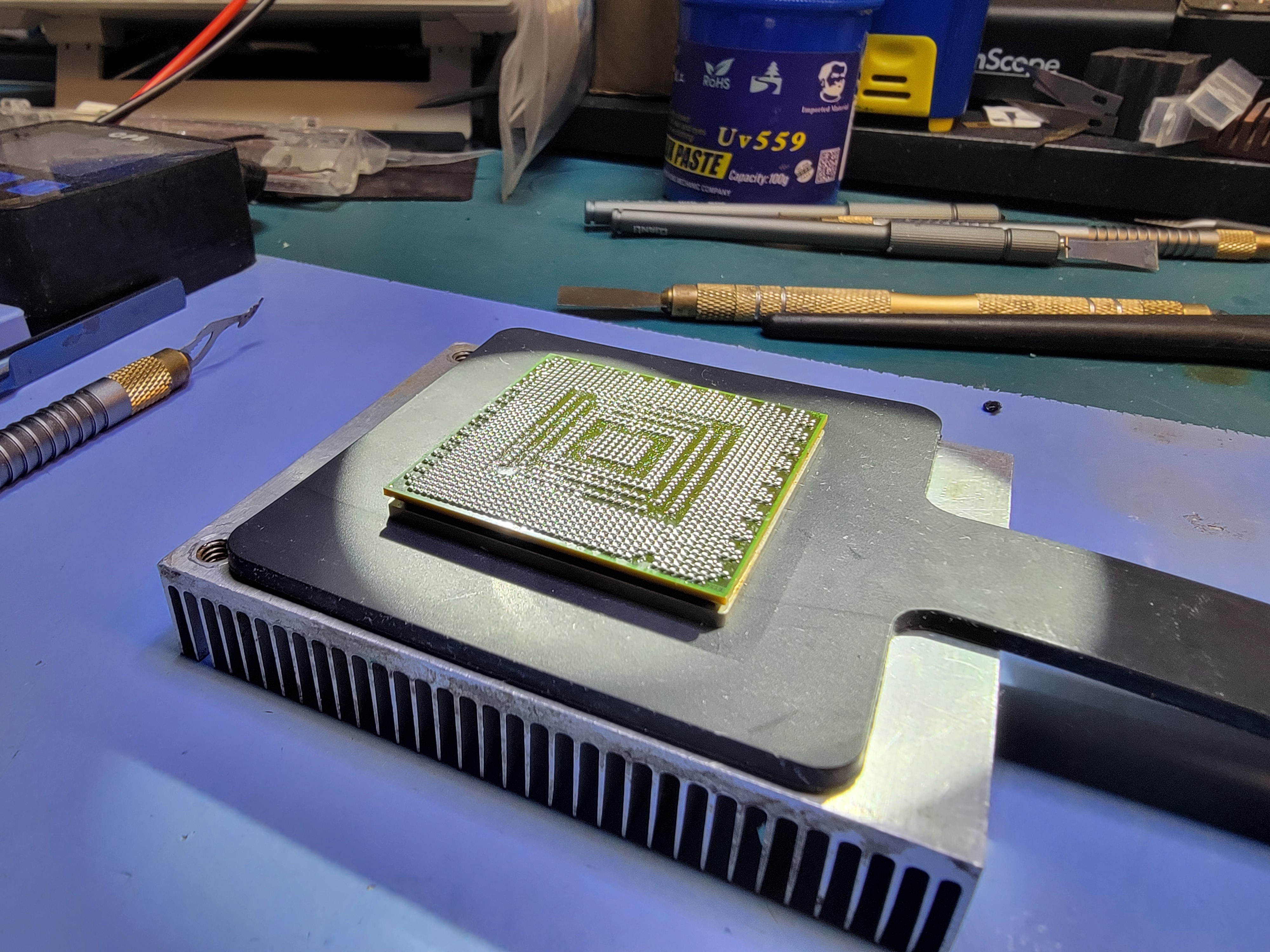
We routinely perform die-level thermal restoration on suitable 65nm RSX processors.
The 65nm package has proven substantially more practical for us to service in this way. Using the proper procedure and tools, we can remove the IHS with controlled mechanical input and access the RSX die without the level of package stress that has caused us to discontinue routine mechanical delidding of conventional 40nm Slim RSX processors.
This does not mean delidding any semiconductor is completely without risk. It remains precision package-level work and the processor is inspected throughout the process.
The difference is that 65nm RSX delidding is an established part of our restoration process when appropriate, while routine 40nm mechanical delidding is not.
The thermal compound beneath the RSX IHS is an internal interface that cannot be serviced during an ordinary external thermal-paste replacement.
Heat generated by the RSX must cross several stages before it reaches the cooling system:
If the hidden thermal material between the silicon and IHS is degraded, replacing paste on top of the IHS does not repair that restriction.
Delidding the 65nm allows us to completely clean and renew this internal interface before the processor enters long-term service inside the Frankenstein console.
Once the 65nm IHS has been removed, the old internal thermal material can be cleaned from the RSX die and heat-spreader surface.
The processor can then receive a completely fresh thermal interface before the appropriate RSX IHS is reinstalled as part of the FAT PS3 cooling stack.
This means the replacement processor does not go into an expensive restoration while depending on an inaccessible aging internal thermal interface.
We have the processor out. We have access to it. On the 65nm package, this is one of the places where we believe renewing the hidden interface makes sense.
The 65nm RSX is also eligible for our optional $20 PTM7950 phase-change thermal upgrade.
Because the processor is delidded during thermal preparation, PTM7950 can be installed directly between the exposed RSX silicon and the heat spreader.
This places the phase-change material at one of the most important thermal junctions in the console: the point where heat first leaves the GPU die.
Traditional premium thermal compound remains an excellent option, but customers building a complete long-term Frankenstein system can add PTM7950 for improved long-term thermal-interface stability and resistance to the migration or pump-out concerns associated with repeated thermal cycling.
For only $20 while the RSX is already being prepared, PTM7950 pairs especially well with the 65nm delid service.
We do not apply one blanket rule to every RSX generation.
Different semiconductor packages can react differently to the mechanical forces involved in separating an integrated heat spreader.
Our experience with conventional 40nm Slim RSX packages, including inspection of mechanically stressed processors, is why we avoid routinely delidding that generation.
The 65nm package has been considerably more serviceable for us, allowing the IHS to be removed with a controlled process and minimal package disturbance when performed correctly.
Therefore:
This is not inconsistency. It is selecting the procedure around the mechanical characteristics and risk profile of the processor being serviced.
We offer both qualified used 65nm donor processors and NOS inventory when available.
Used 65nm - $225: a qualifying later-generation RSX recovered from compatible Sony hardware, inspected, electrically evaluated, professionally prepared, reballed and installed as part of the Frankenstein conversion.
NOS 65nm - $325: unused 65nm RSX inventory for customers who prefer unused replacement silicon when available.
Both options receive the same professional installation process, electrical configuration, thermal preparation and post-installation testing.
The difference is the previous operating history of the processor itself.
A donor console producing video does not automatically make its RSX suitable for a premium Frankenstein restoration.
Before a processor is approved for customer use, we inspect the package and electrically evaluate the important RSX power domains. Processors showing abnormal readings, physical damage or other characteristics outside our accepted donor criteria are rejected.
This is especially important because installing an RSX is one of the most labor-intensive operations performed on the motherboard. It makes little sense to invest that amount of BGA work into a questionable processor.
A 65nm Frankenstein conversion is complete motherboard-level BGA rework.
The process can include:
This is replacement of the failed processor, not reheating of the original processor.
A 65nm RSX is not electrically identical to the original 90nm GPU.
The motherboard must be correctly configured for the later RSX generation so that the replacement processor receives the appropriate operating conditions and the system correctly initializes it.
The required Frankenstein voltage configuration is part of converting the console to the later processor.
This should not be confused with our optional CELL/RSX undervolting package.
Conversion voltage configuration establishes the electrical conditions required by the replacement 65nm RSX.
Optional undervolting is additional optimization performed after the conversion to further reduce electrical power and heat where the individual silicon remains stable.
Low firmware is exactly why a customer may want the 65nm RSX, so we do not blindly update or alter a historically interesting console before understanding its configuration.
Before finalizing the RSX choice, we consider:
If maintaining a particular firmware version is important, tell us before service begins.
Low-firmware preservation can change which RSX we recommend and how the conversion must be approached.
Normally, that is exactly what we recommend.
If the console will be operated on a modern firmware configuration and the customer wants our highest-tier overall Frankenstein build, our factory bare-die 40nm RSX is the processor we prefer.
But the most advanced processor is not automatically the correct processor for every restoration.
If installing the 40nm would force a historically significant console out of the firmware environment the customer specifically wants to preserve, then the modification would defeat the purpose of the restoration.
The 65nm exists in our lineup because sometimes compatibility is more valuable than chasing the smallest semiconductor process.
A 65nm Frankenstein can still receive nearly every other premium restoration option we offer:
A customer choosing 65nm for firmware compatibility therefore does not have to sacrifice the rest of the Premium restoration package.
Premium factory bare-die 40nm: our preferred overall configuration when there is no reason to preserve very early firmware.
Standard 40nm: excellent later-generation RSX conversion at a lower price while retaining the replacement processor's factory IHS.
65nm: our specialist option for customers who need earlier-firmware compatibility, native OtherOS-era operation, or another restoration requirement that makes 40nm inappropriate.
There is no reason to force the same processor into every console. We choose the RSX around what the finished system is supposed to accomplish.
If you do not need low firmware, we generally recommend moving up to our Premium factory bare-die 40nm RSX.
But if preserving native OtherOS, early firmware or another period-correct software configuration matters, the 65nm RSX becomes one of the most valuable Frankenstein options available.
It gives the console later-generation silicon without automatically forcing the restoration into the later 40nm firmware environment, and unlike our conventional 40nm Slim RSX service, the 65nm package allows us to routinely renew the hidden die-level thermal interface using our established delid process.
For a modern no-compromise build: Premium 40nm. For a low-firmware or native OtherOS build: 65nm is the specialist choice.
Premium Packages Customized to your budget.
Related Service Options
Most premium restorations combine multiple hardware services depending
on the condition of the console.